A Step Backward for Rural Conservation: Changes to Minnesota’s CPL Grant Program Leave Greater Minnesota Behind
For years, Minnesota’s Conservation Partners Legacy Grant Program has been one of the most effective ways for local conservation organizations to turn good ideas, volunteer effort and local partnerships into real habitat improvements on the ground.
Organizations like the Minnesota Deer Hunters Association and our local chapters understand the value of that model. Our members live in these communities. They hunt these lands. They volunteer their time. They work with land managers, conservation partners and local contractors to improve habitat that benefits deer and countless other wildlife species.
Unfortunately, a significant change approved by the Minnesota Legislature for Fiscal Year 2027 threatens to leave much of Greater Minnesota out of that process.
And we believe Minnesota hunters and conservationists deserve to know what happened.
What Is the CPL Program?
The Conservation Partners Legacy Grant Program, commonly called CPL, is funded through Minnesota's Outdoor Heritage Fund and administered by the Minnesota Department of Natural Resources.
CPL was created to encourage and support local conservation efforts by providing matching grants to nonprofit organizations and government entities for projects that restore, enhance or protect forests, wetlands, prairies and habitat for fish, game and wildlife.
Since its creation, CPL has become an impressive conservation success story. According to state program information, CPL has provided more than 1,000 grants, distributed more than $100 million and helped restore, enhance or protect hundreds of thousands of acres of wildlife habitat.
The program works because it puts conservation dollars into the hands of organizations capable of identifying needs and getting work done locally.
That model is particularly important in rural Minnesota.
What Changed?
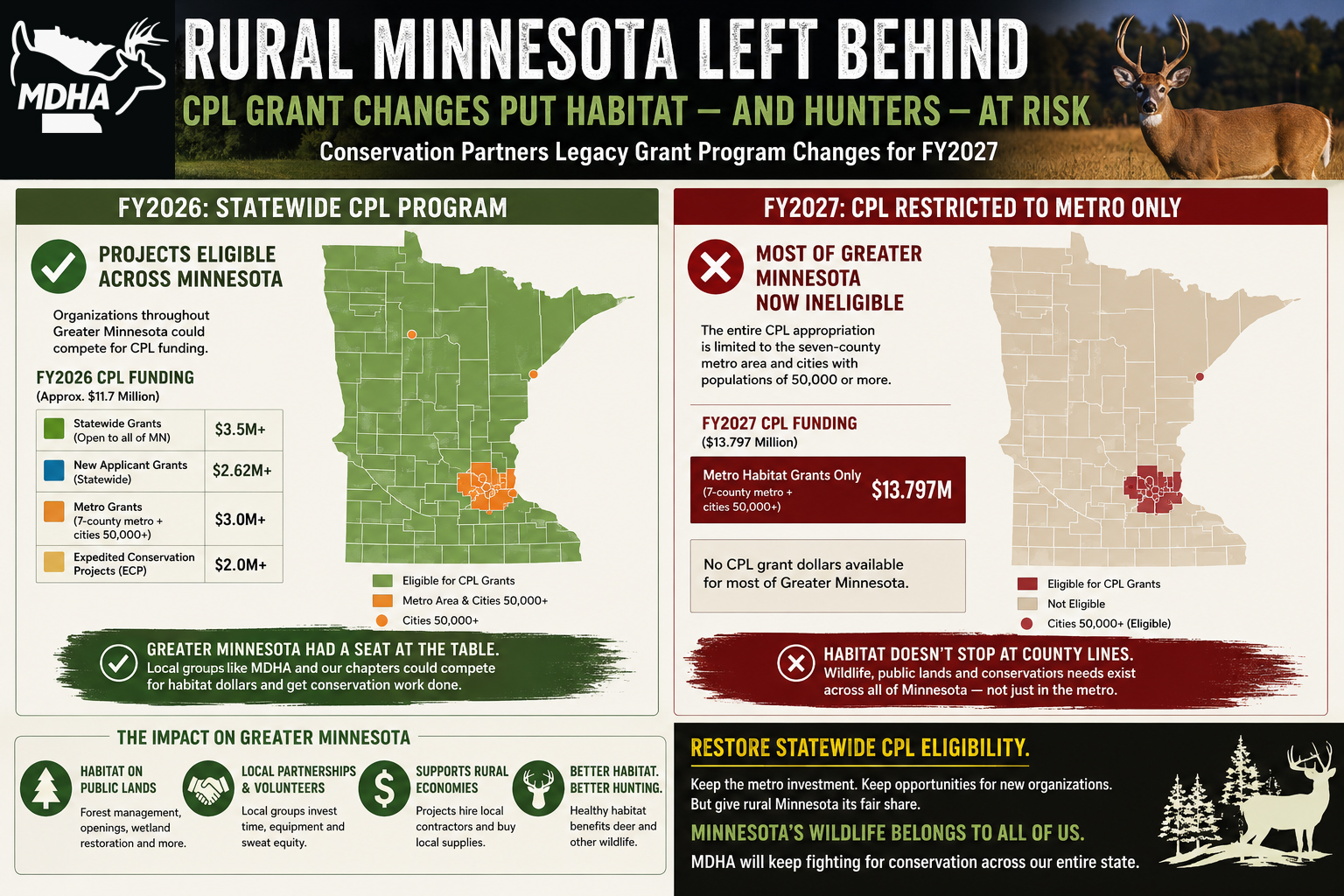
For Fiscal Year 2026, the CPL program received approximately $11.7 million and remained a statewide program.
While at least $3 million was designated for projects in the seven-county Twin Cities metropolitan area and cities with populations of 50,000 or more, organizations throughout Greater Minnesota could still compete for CPL funding.
That changes dramatically for Fiscal Year 2027.
The final Outdoor Heritage Fund legislation appropriates $13.797 million for what is now specifically called:
“Conservation Partners Legacy Grant Program: Metro Habitat.”
Under the new language, CPL grants from this appropriation are limited to habitat projects located within the seven-county metropolitan area or cities with populations of 50,000 or more.
That means organizations working across huge portions of rural Minnesota can no longer compete for these CPL dollars.
This isn't simply a metro funding set-aside.
For FY2027, the entire $13.797 million CPL appropriation is geographically restricted.
That Wasn't the Original Proposal
Perhaps the most troubling part is that this wasn't how the proposal started.
Earlier FY2027 CPL legislation called for approximately $13.8 million for the “Conservation Partners Legacy Grant Program: Statewide and Metro Habitat, Phase 18.”
Under that proposal, projects could occur throughout Minnesota. At least $3.5 million would have been reserved for the metro and cities over 50,000 population, while another $3 million would have been reserved for organizations that had never previously applied for Outdoor Heritage Fund money.
In other words, the metro would have received a substantial guaranteed investment while Greater Minnesota remained eligible.
That seems like a reasonable balance.
Instead, during the closing days of the 2026 legislative session, the statewide language disappeared.
The final legislation changed the program from “Statewide and Metro Habitat” to simply “Metro Habitat.”
The words matter.
So does the impact.
Who Supported the Change?
Minnesotans should understand that this was ultimately a bipartisan legislative decision.
The conference committee that agreed upon the final version of SF 2077 included Senators Foung Hawj, Aric Putnam and Andrew Lang, along with House members Josh Heintzeman, Joe McDonald, Samantha Vang and Peter Fischer.
The conference committee report containing the metro-only CPL language was signed by those conferees and sent back to the Legislature for final approval.
The Senate ultimately repassed the legislation 47-20, and the House repassed the conference committee version 111-22.
Governor Tim Walz subsequently approved the legislation on May 27, 2026.
That doesn't necessarily mean every legislator voting for the large Outdoor Heritage omnibus bill specifically supported removing Greater Minnesota from CPL eligibility. These bills contain dozens of individual conservation appropriations and policy provisions.
But the fact remains:
The metro-only CPL language was contained in the legislation they approved, and it became law.
Why MDHA Believes This Is Unfair
MDHA strongly supports conservation work in the Twin Cities metropolitan area.
Wildlife habitat near population centers matters. Access matters. Wetlands, grasslands, forests and wildlife corridors in developing areas deserve protection.
This should never become a question of metro conservation versus rural conservation.
Minnesota needs both.
The problem is that the new CPL structure guarantees one part of Minnesota access to these locally driven conservation dollars while excluding enormous portions of the state.
Consider the reality of Minnesota's wildlife resources.
Some of our state's largest forests, wildlife management areas and public hunting lands are located in rural Minnesota. These landscapes support whitetail deer, ruffed grouse, waterfowl, bear, moose and countless nongame species.
They also require active management.
Forest openings need maintenance. Aging forests need treatment. Invasive species need control. Grasslands require restoration. Browse and early-successional habitat need to be created. Public lands need partners willing to provide the money, equipment, volunteers and organizational capacity necessary to accomplish that work.
Those needs don't disappear because the nearest city has fewer than 50,000 residents.
What This Means for MDHA Chapters
For MDHA, this issue is not theoretical.
Our organization and chapters have a long history of putting money and volunteer effort directly into Minnesota's wildlife habitat.
MDHA has participated in habitat improvement and land conservation efforts across Minnesota, often working cooperatively with the DNR, counties, federal land managers and other conservation organizations.
These projects happen where deer habitat exists — and much of that habitat is in rural Minnesota.
Under the FY2027 CPL language, a local conservation organization could identify an outstanding habitat project on public land in northern, central or western Minnesota.
It could have local volunteers ready to help.
It could have matching funds.
It could have the support of the land manager.
It could demonstrate clear benefits to wildlife and public recreation.
Yet simply because that project falls outside the designated population areas, that organization could be unable to apply for these CPL funds.
To MDHA, that doesn't make sense.
Habitat quality should determine whether a habitat project deserves consideration — not the population of the nearest city.
Rural Conservation Also Supports Rural Communities
There's another part of this conversation that shouldn't be overlooked.
Habitat projects are also economic activity.
Conservation organizations hire forestry contractors, loggers, excavators, equipment operators and other local businesses. Equipment needs fuel and maintenance. Seed, herbicide, materials and supplies are purchased. Contractors hire employees.
In many cases, CPL dollars invested in rural habitat circulate through the rural economy while producing a permanent public conservation benefit.
Pioneer Heritage Conservation Trust, another rural Minnesota conservation organization, has publicly raised this same concern. Its president, Michael Nemmers, wrote to Governor Walz opposing the change and pointing out that CPL-supported projects frequently utilize local contractors, equipment and supplies.
MDHA shares that concern.
Removing rural organizations from CPL doesn't only remove an opportunity to improve wildlife habitat. It removes an important tool for locally driven conservation.
Greater Minnesota Shouldn't Have to Choose
We want to be very clear:
MDHA is not asking the Legislature to take habitat funding away from the metro.
The previous structure already guaranteed millions of dollars for metro-area projects.
Keep that commitment.
What we oppose is accomplishing that goal by shutting rural Minnesota out of the program.
Minnesotans across the entire state pay the sales tax that funds the Outdoor Heritage Fund.
Hunters, anglers and conservationists across the entire state supported the Legacy Amendment.
And wildlife habitat worthy of restoration and protection exists across the entire state.
A program created to encourage local conservation efforts should not tell hundreds of rural communities that their local conservation projects are no longer eligible because they fall on the wrong side of a population line.
MDHA Calls for Statewide CPL Eligibility to Be Restored
The Minnesota Deer Hunters Association believes the Legislature should restore statewide eligibility to the Conservation Partners Legacy Grant Program in the next legislative session.
A dedicated metro allocation can remain.
Programs encouraging new organizations to participate can remain.
But rural conservation organizations must once again have an opportunity to compete.
Minnesota has built one of the strongest conservation traditions in the country because hunters, anglers, conservation organizations, landowners and government agencies have worked together.
CPL has been a successful piece of that partnership.
We shouldn't weaken it by drawing an arbitrary geographic boundary around who gets to participate.
Minnesota's wildlife belongs to all Minnesotans. Minnesota's Outdoor Heritage Fund is supported by Minnesotans statewide. And Minnesota's conservation opportunities don't stop at the edge of the seven-county metro or the city limits of communities with 50,000 residents.
Greater Minnesota deserves a seat at the table.
MDHA will continue advocating for conservation policies that protect Minnesota's wild deer, improve wildlife habitat, preserve public hunting opportunities and ensure the hunters and conservationists doing this work in communities across our state have a voice.
DO YOU THINK GREATER MINNESOTA DESERVES A VOICE?
Join the thousands of hunters standing with the Minnesota Deer Hunters Association. The more members we represent, the stronger our voice becomes when decisions affecting deer, habitat and hunting are made at the Capitol.
JOIN MDHA — ADD YOUR VOICEYour membership helps MDHA advocate for:
- Wildlife habitat and public hunting lands
- Science-based deer management
- A strong voice for hunters at the Minnesota Legislature
- Minnesota's deer hunting traditions
- Youth outdoor education and Forkhorn Camps
More Members. More Influence.
A Stronger Voice for Minnesota's Deer Hunters.

Minnesota Deer Hunters Association
460 Peterson Rd
Grand Rapids, Minnesota 55744