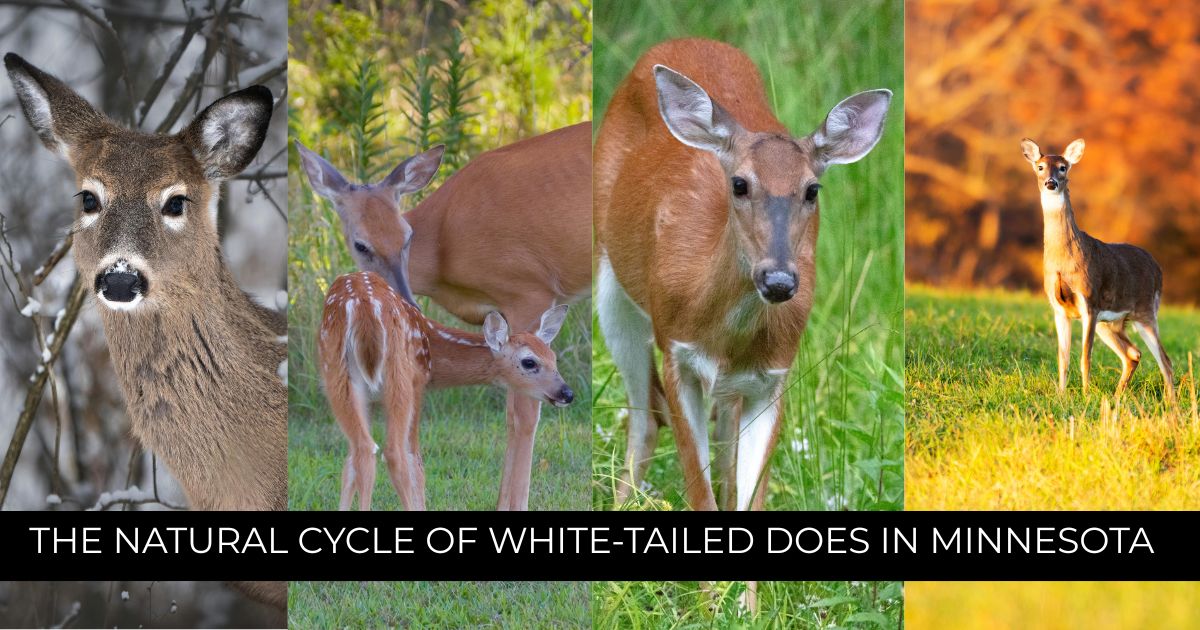
Does and Fawns in Summer
We have been following our doe, born last spring in Minnesota’s prime deer habitat, the transition zone, where she grew rapidly through the summer and fall. She experienced her first estrus cycle in early winter and attracted an adult buck. When we left her, she rejoined her maternal family group to shelter in place for the winter after being bred. She entered winter in good condition with ample fat reserves and due to the fairly mild snowpack and temperatures, she is still doing well and is now nearing time to give birth.
Our doe faces heightened challenges as a first-time mother at a young age. Her first test as a mother will be when she goes into labor. The average gestation time from breeding to birth for a white-tailed deer is 200 (+/-5) days or 6.5 months. Based on the gestation time, our doe is expected to give birth sometime in June or perhaps even July, which is considered a late birth and may not bode well for her fawn. Fawn survival is tied to birth timing and size. Fawns born too late may not have enough time to grow large or strong enough to survive the upcoming winter. Conversely, fawns born too early prior to the spring green-up will be exposed to more extreme weather conditions and the doe will be faced with an increased risk of malnutrition or death due to the high energy demands of lactation. Being born outside of the peak fawning period also means the fawn would be easy picking for predators.
Giving birth within the same short time frame ensures predators are not able to consume all the vulnerable fawns in an area before they can successfully evade predation, a phenomenon known as “predator swamping”. On the other hand, if the doe is able to carry the fawn as long as possible before birthing (towards the far end of the gestation range), her fawn is likely to be larger. Fawns that are born larger have a head start on growing fast enough to survive winter even if they were born later. Size is also partially dependent on whether a fawn is a singleton or part of a twin pair. Twins are born smaller but are an indicator of good habitat conditions. Twins are riskier compared to singletons, but if successful, a doe will double her chance to ensure her genes survives for another generation. Single fawns also typically have heavier birth weights compared to twin fawns. However, fawns born to young does tend to be smaller on average. Despite the challenges the doe will face, she will have access to good habitat and nutrition in the transition zone once spring has arrived.
What our doe chooses to feed herself is also key to her fawns’ survival. With the arrival of spring, deer diets will change drastically. Does need sufficient nutrition to replenish diminished fat reserves as well as support their growing fetuses. Pregnant does need 16-20% protein in their diet to support healthy fetal development. After giving birth, the mothers will still require a high protein diet to produce sufficient milk. As a comparison, mature, nonbreeding does can sustain themselves on a diet with protein concentrations as low as 8%.
The different plant species a deer will consume have varying concentrations of protein and other nutrients they need and are available at different times of the year. In early spring, deer can be seen feeding on young grass shoots and the newly emergent green forbs (herbaceous broadleaf plants). This is the only time of the year when grasses are an important part of a deer’s diet because there are not enough forbs growing yet to support their nutritional needs. Grasses are also low in protein and palatability. As spring progresses, deer quickly abandon grasses for better options like young forbs. By mid-spring, forbs make up about 50% of their diet. Some common species like alfalfa and clover can contain more than 25% protein and are very digestible, making them highly preferred by deer.
Other species like ragweed, bunchberry, wild strawberry, and young ferns are some other examples of vegetation that deer love to consume when they are available. Once green-up is fully underway, a deer’s diet becomes more diverse, consisting of two-thirds forbs and the remaining third, fruits, leaves, shrubs, and agricultural crops.
Diet, however, is not the only important aspect of a pregnant doe’s home range. The ideal habitat will also have a good mixture of escape or hiding cover as well as thermal cover. This diverse habitat will provide the deer with shade during the hot days and dense vegetation to help hide from predators and human disturbance. At the same time, the understory should have enough openings to help promote good air flow. A doe’s ideal spring habitat may differ slightly than what an adult buck may prefer. During the summer, white-tailed deer are still segregated by sex to accommodate their differing nutritional and shelter needs. Bucks also require more protein in spring and summer for their rapidly growing antlers, and to replenish fat reserves lost over the physically demanding rut and winter, but their risk tolerance will be different than a pregnant doe.
For our doe, the lack of disturbance will be key when she searches for a good birthing area. What does a good place for birthing look like? Ideally, she will seek locations that have high quality forage and a low understory with a partially shaded overstory. However, does will prioritize, albeit with a tradeoff, safety from predators over quality forage habitat. In areas with predators like wolves, coyotes, bears, or humans, does will choose dense understories away from common predator travel corridors such as roads, waterways, and crops. Once our doe finds a good location and is ready to give birth, she will isolate herself from her family members. The time of isolation during and after birthing minimizes the risk of attracting predators to the group, and to give the mother time to bond with the fawn without interference from other does.
When our doe starts laboring, the process occurs very quickly. For white-tailed deer, active labor typically last only half an hour. There can be birthing complications, depending on the doe’s body condition prior to giving birth. For example, if a doe is malnourished, she may be more likely to reject the fawn or not produce sufficient milk. In our doe’s case, she is in good physical condition so chances of rejecting her fawn are low. As a first-time mother, our doe ends up giving birth to a singleton female as despite how frequently twinning occurs in white-tailed deer, the typical litter size for young mothers is one fawn. The first thing the doe will do after giving birth is to consume the placenta and any remaining afterbirth – which provides some nutrition for our new mother. Mere minutes after the fawn is born, she is able to take her first steps toward her mother for a drink. During the first nursing session, the fawn will learn her mother’s scent which will assist the fawn in identifying her mother once she and her mother rejoin the family group. While the fawn is nursing, the mother will lick the fawn’s behind to help stimulate waste movements and consume any waste. These behaviors help to minimize attracting predators to the birthing site and is also part of the bonding process between mother and fawn.
The first few ounces of milk our doe produces will be a slightly different composition called colostrum. It is vital for her fawn’s survival to drink the colostrum within 24-36 hours of her life as the colostrum will pass down the mother’s antibodies to provide the foundation of the fawn’s immune system. Once the colostrum runs out, the mother will produce regular milk for the fawn. Further evidence of the reproductive tenacity of white-tailed deer is that, regardless of the mother’s health, the composition and nutritional quality of her milk remain the same. The only difference in milk provided by a doe in poor health versus a doe in excellent health is the volume being produced. Mothers in poor health will struggle to produce sufficient milk to help the fawn grow while a doe in excellent health will produce sufficient milk for her fawn.
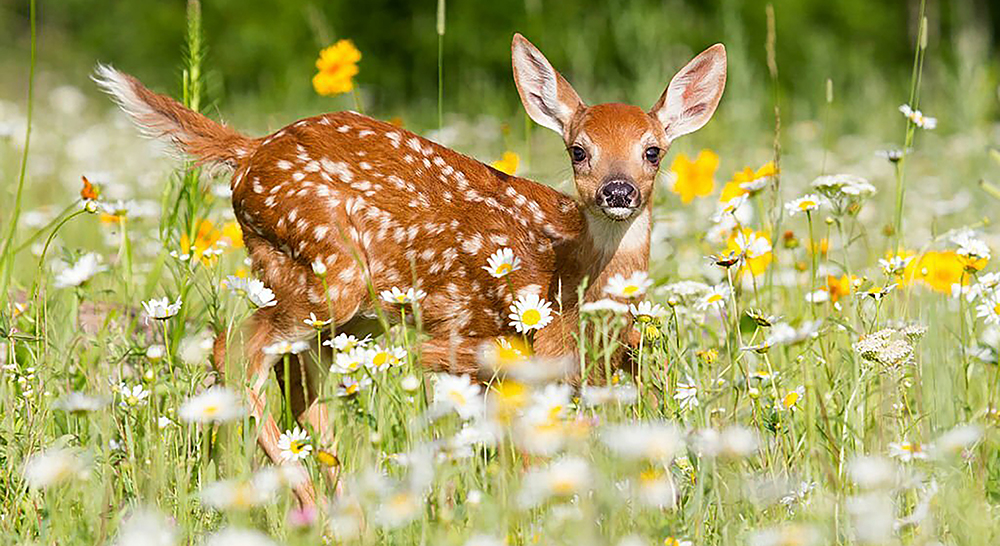
For the first few weeks of her life, a white-tailed deer fawn’s best defense from predators is to avoid detection. With guidance from her mother, the fawn will hide in a secluded section away from the birthing area and the mother will leave for hours at a time. While this may seem risky, fawns have many adaptations that make them effective at hiding, including being well camouflaged with their surroundings. Brown fur allows fawns to blend in with dry grasses and dead leaves that scatter the forest floor, and their white spots break up their outline and mimics sunlight dappling the ground. White-tailed deer fawns have an average of 300 spots along their back and sides, with each spot being up to half an inch in diameter. Once a fawn is three or four months old, they lose these spots during their first adult molt. Prior to the first molt, fawns will utilize their camouflage to hide between visits from their mother who will return intermittently throughout the day to feed the fawn. This is a pattern that repeats for about two weeks, and as the fawn ages, her survival strategy will change from hiding to following her mother. Then it will be time for the mother-fawn pair to rejoin the family group.
After rejoining the family group, our fawn will continue nursing for 4 to 6 months, until her mother decides that it is time for weaning. The fawn can be completely weaned in as little as 8-10 weeks with no adverse effects although she will nurse as long as she can if her mother does not cut her off. Before being weaned, the fawn’s body will gradually prepare for the inevitable cutoff from her mother’s milk. Throughout the nursing period, the fawn gains her first gut microbes through her mother via the bacteria from nursing and exposure to the doe’s feces. After consuming solids for the first time, the fermentation process to digest the food will produce more gut microbes for the fawn. However, milk entering the rumen would have an adverse effect on her burgeoning microbe community.
To ensure any milk does not enter the rumen while the fawn is still nursing, all fawns will have an esophageal groove that bypasses the rumen and enters the fawn’s abomasum or “true stomach”. As the summer progresses, our fawn will start to consume more solid foods as she grows and learns how to select the best forage available in preparation for weaning. By late summer, this would include shrubby vegetation as other forbs from early spring would become bitter and less palatable. In early fall, the fawn may be lucky enough to experience some delicious treats if the trees drop their acorns early enough.
Our doe has done a good job of setting up her fawn for success. Although the fawn is at a disadvantage of being born late—she was born with a healthy weight, her mother has access to excellent habitat, and she will have plenty of time throughout the summer to grow. Our fawn made it past the highest mortality time period for deer – the neonatal stage, safe and sound. If the area receives adequate spring rainfall this year, the doe will have no problems lactating and producing sufficient milk volume. All the fawn has to do is focus on eating and growing as much as she can before fall and the rut period arrives for the fawn’s family group.



Minnesota Deer Hunters Association
460 Peterson Rd
Grand Rapids, Minnesota 55744