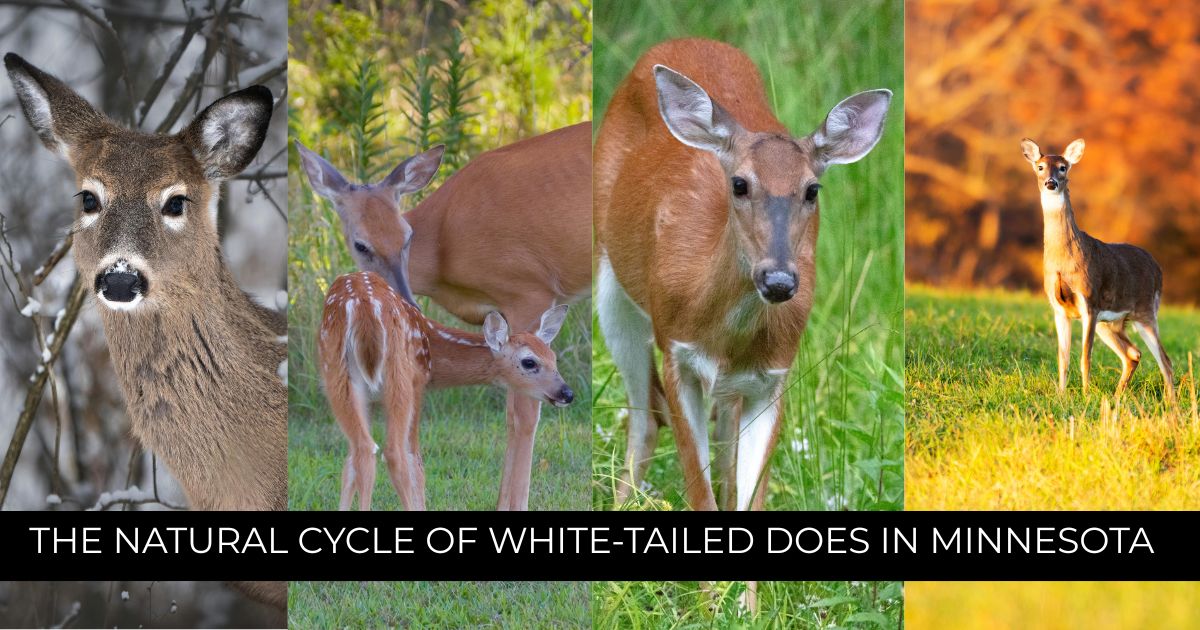
The Natural Cycle of White-tailed Does in Minnesota
When winter settles in across Minnesota, sometimes early, sometimes late, other times in the middle, temperatures will vary from moderate to bitter lows throughout much of the state. For sure, the days will become shorter until the winter solstice on December 21 or 22, and more often than not, our lands and lakes will lay quiet under a blanket of snow of varying depths. In these often brutal conditions, survival is a constant challenge for white-tailed deer. Yet, they have proven to be remarkably tough.
In that “remarkably tough” vein, deer have several tricks up their sleeves to deal with Minnesota winters, including a thick winter coat specially designed with hollow hairs that trap heat close to the body. They also lower their metabolism during winter to minimize energy expenditures. This serves deer well because food can be tough to find in Minnesota’s fields and forests during the winter, with twigs, evergreen browse, and bark often comprising much of a deer’s diet. In some cases, in fact, it can cost more energy to digest winter forage than the animal gains through calories. For the most part, in fact, deer rely heavily on the fat reserves they gained during the spring, summer, and fall to sustain them over the nutritionally restrictive winter, emphasizing the need for quality pre-winter habitat and forage.
As ruminants, deer house an entire ecosystem in their four-chambered stomachs that fluctuates along with the seasons, slowly changing throughout the fall to a community of microorganisms that are well suited to digest woody material. After a certain point, even if there were an unexpected food windfall, a deer would not be able to digest the food properly due to the changing bacteria and slowed digestion response. This would cause energy loss the deer might not be able to afford during severe winters. Finally, the company that deer keep also works to their advantage. In early winter, deer will start congregating into large herds split by sex – a strategy known as “sexual segregation.” Congregating in groups helps deer better detect predators and reduces the probability that any individual deer will be killed. But, because males and females have different priorities during winter, one sex trying to maximize survival by avoiding predation and the other trying to maximize the likelihood her pregnancy is successful (more on this later), they may occupy slightly different habitats to meet those needs.
By far the most significant challenge deer face during a Northern winter is deep snow. Their long slender legs punch through the snowpack with every step – a struggle any Minnesotan can appreciate if they have trudged through drifts without snowshoes. Wolves, the primary predator of deer in northern Minnesota, are far better equipped for these conditions, moving easily across the snow on broad, flat paws. Therefore, much of wolf predation on deer, and nearly all predation of wolves on adult deer, occurs during the winter, and is heightened during winters with deep snowpacks. Deep snow also makes finding what little forage is left that much more difficult for a deer.
To overcome these obstacles, deer seek areas with dense canopy cover where the snow has settled on the coniferous treetops, rather than the forest floor. In these areas, shallower snow offers respite from the elements, leaves more forage exposed, and allows for easier movement when escaping predators. Known as “deer yards,” these sites may be visited year after year by the same animals and their offspring, depending on the severity of the winter.
In general, a “deer yard” area needs to have at least a 70% canopy cover to be considered a good winter deer yard. Some tree species commonly found in deer yards include cedar, fir, pine, spruce, and hemlock. Another important factor in deer yards is a thick protective cover for predator evasion. With many deer using the same areas, networks of trails will develop, providing deer with good escape routes from predators. The abundance of these winter deer yards on the landscape is key to deer survival during a severe northern Minnesota winter.
Although winter is considered a time of hardship and restriction for deer, it is also a time of renewal and creation as this marks the earliest stage of pregnancy for does. The time during a doe’s reproductive period when she mates and can conceive is known as “estrus.” With adequate nutrition, white-tailed deer does can enter their first estrus as early as six-months of age. Still, these younger females tend to conceive later than older does as they are more likely to need extra time to reach the required weight to undergo estrus. In most white-tailed deer populations in the Midwest, the pregnancy rate for adult does is very high, with most does in a population becoming pregnant every year. If the doe was not bred during her first estrus in the fall or the pregnancy fails early, it will cycle through estrus every 28 days until they are bred, up to six times in a year!
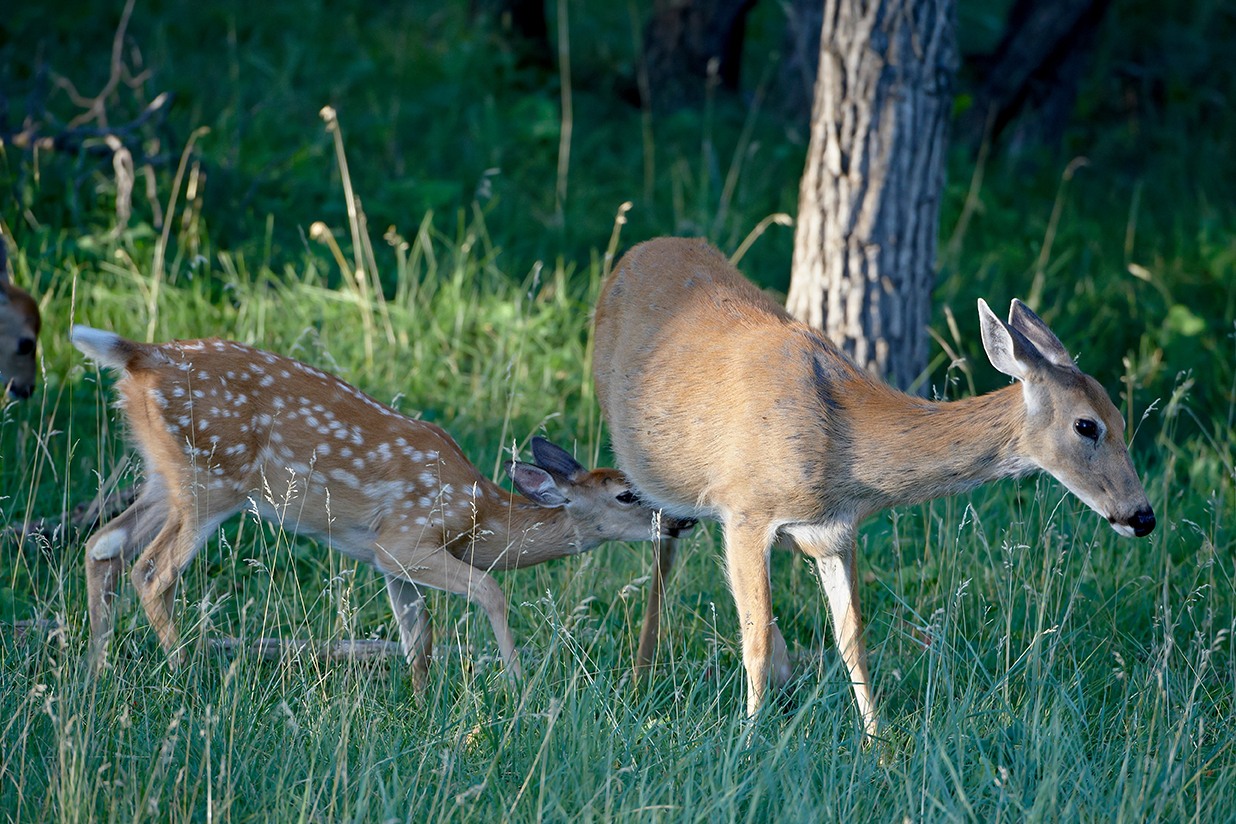
Once pregnant, a doe typically will not miscarry or reabsorb the fetus unless it has an abnormality and is nonviable, or the doe is very close to death from starvation. White-tailed deer does are proven to be excellent mothers, and their bodies will do everything possible to hang onto a viable fetus. Even while heavily stressed or starving, the doe will keep the pregnancy to the detriment of her own body condition. Pregnancy puts a heavy demand on the doe’s body, so she must be intentional about what she eats to balance the nutritional value of the food and various factors such as palpability, digestibility, food abundance, and the risk to access said food. Because of these demands, the doe may seek more risky areas to forage if it means the forage quality is higher, while bucks may opt to stay safe under heavy cover, but less access to forage.
As you can see by now, there is a lot going on during winter for white-tailed deer. However, although Minnesota is known for its hard winters, it is a large state with diverse habitats ranging from the subboreal coniferous forestland of the north to the open farmland and prairie of the northwest and southwest, to the eastern broadleaf woodlands of the transition zone in between. Each region experiences winter a little differently. That makes it difficult to generalize what a deer could experience since they can face differing challenges and conditions depending on where they live. If we zoom in a little closer, we can hypothetically, but in a biologically sound manner, follow a single doe’s life to better understand what that doe might experience as we follow it throughout the entire year.
The preceding spring, our theoretical doe fawn was born in mid-May in Minnesota’s transition zone. The transition zone in Minnesota marks the best deer habitat in the state, consisting of a mix of hardwood and coniferous woodlands interspersed with forage openings and “edgy” areas with a diversity of forb species that deer love. This doe was born in a home range that received adequate spring rainfall to promote lush vegetative growth and has not been impacted by severe winters in the past few years. Thanks to this, the doe fawn was able to survive the hurdle of her first 30 days of life to grow rapidly throughout the summer.
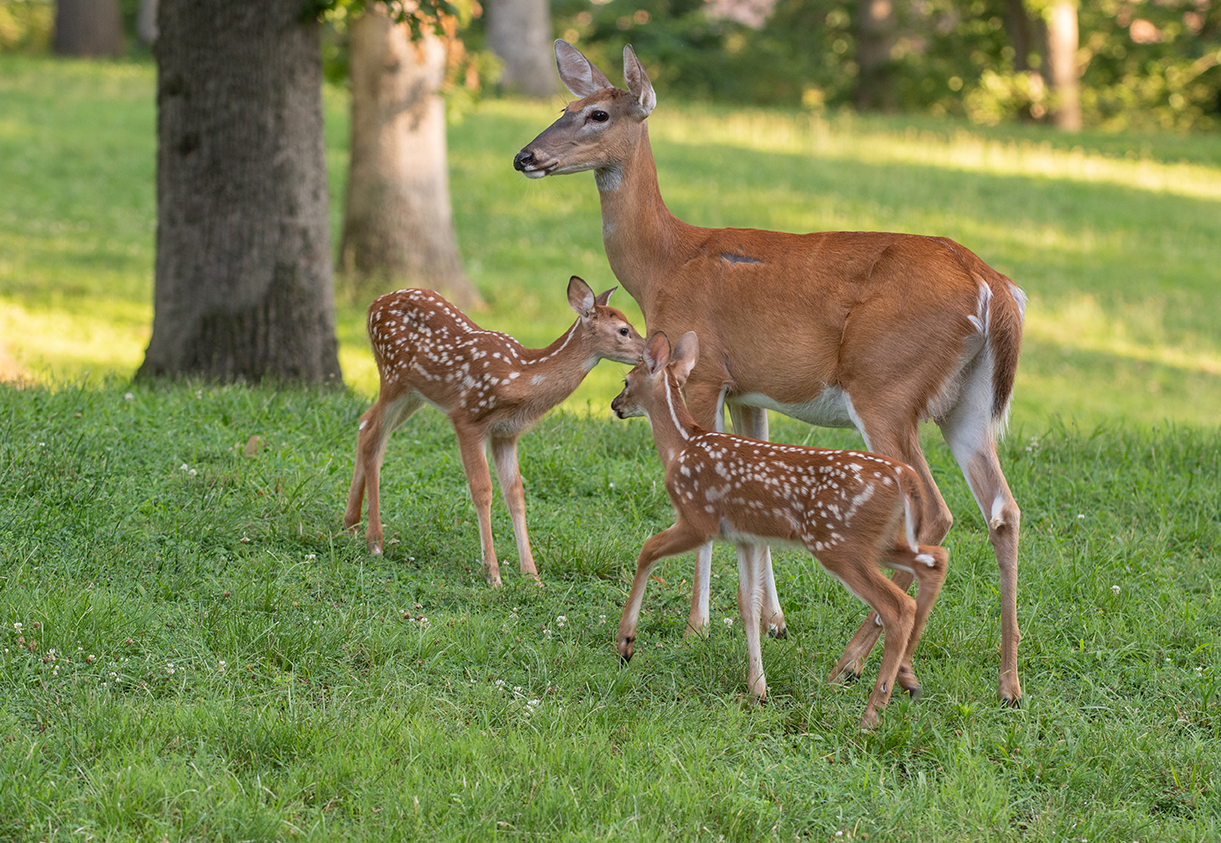
As this doe fawn entered fall, she continued growing at a good rate by taking advantage of the bumper acorn crop that occurred and entered winter with plenty of fat reserves. By early December, the doe fawn accumulated enough body mass (70 lbs.) to undergo estrus for the first time. The doe fawn experienced estrus just in time to catch the tail end of the rut. A buck wandering through her home range became aware of her presence and receptibility to breeding by visiting nearby scrapes. The buck stayed with the doe fawn for 24 to 36 hours for the entire duration of the doe’s estrus. Bucks will breed with any doe in estrus regardless of the doe’s body size. While doe fawns and yearlings have a lower pregnancy success rate compared to adult does, they are still highly likely to become pregnant if they have the right body mass and enough fat reserves to support a pregnancy.
As it is the doe fawn’s first pregnancy, it is unlikely that she will have twins. She will also be less likely to have a fawn survive to one-year of age compared to a mother in her prime and may be less likely to reproduce successfully the next spring given the demands of pregnancy and lactation on her body during her first winter and spring. But, that will depend on how severe the upcoming winter is, the timing of spring green-up, and whether her accumulated fat reserves were affected by the timing of her own birth and the condition of her mother.
After being bred, the doe fawn has now rejoined her family group to shelter in place for the winter. With her fat reserves full, the doe fawn is prepared to wait out the winter if there is minimal to normal disturbance of her home range. Her pregnancy will last about seven months until spring when she will give birth for the first time.
And the natural cycle continues…

Minnesota Deer Hunters Association
460 Peterson Rd
Grand Rapids, Minnesota 55744