- Roy Welch
- From Whitetales
- Hits: 3562
Performance of small-caliber cartridges
- Roy Welch
- From Whitetales
- Hits: 3562
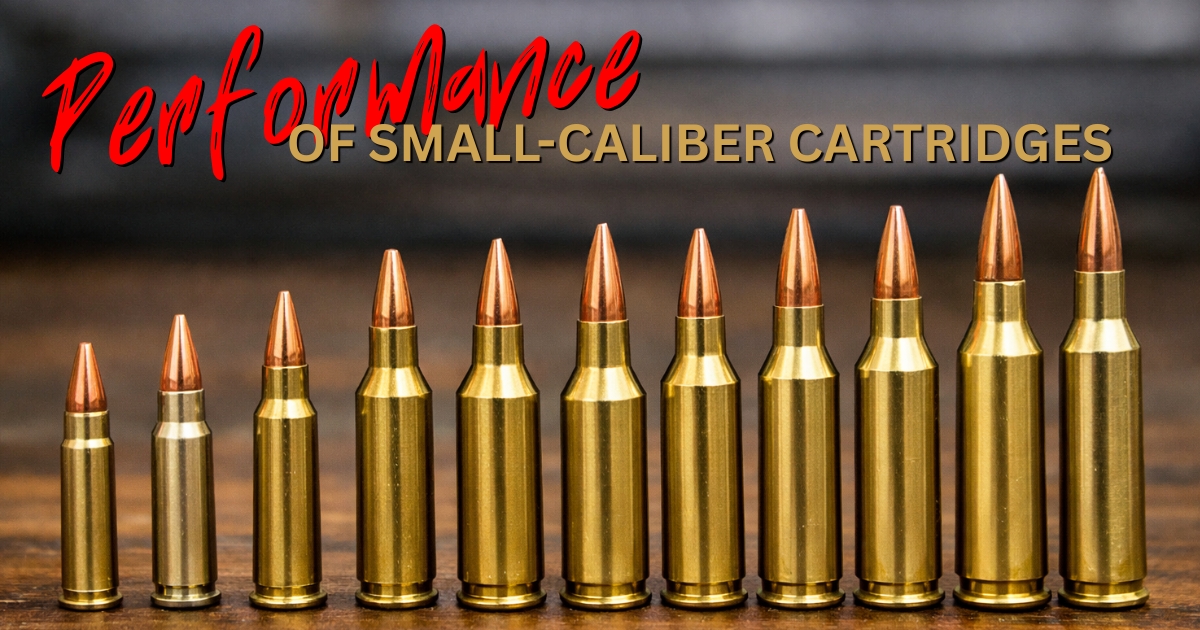
Spurred on by a combination of factors, including the growing interest in long-range shooting, availability of high ballistic coefficient bullets, new powders, rifles with fast-twist barrels, and the popularity of AR-15 style rifles, there has been a surge in the development of small-caliber cartridges over the last 20 years.
These cartridges can be grouped in three categories: 1) .17-rimfire and centerfire cartridges; 2) .20- and .22- caliber cartridges; and 3) 6mm cartridges.
A review of these cartridges may help to determine which cartridges are optimal for particular tasks. It is beyond the scope of this article to review individual cartridges in detail. However, I will attempt to summarize key characteristics, and also consider which cartridges are suitable for deer-sized game.
.17-Caliber Rimfire and Centerfire Cartridges
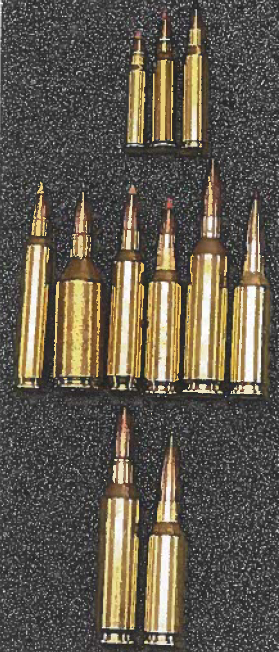
Three cartridges in this category include the rimfire .17 Hornady Magnum Rimfire (HMR) and .17 Winchester Super Magnum (WSM), and the centerfire Hornady .17 Hornet.
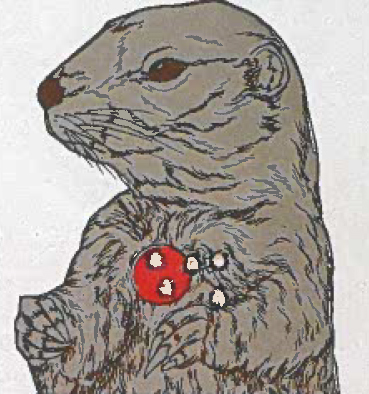
The .17 HMR, introduced in 2002, quickly became a competitor of the Winchester .22 Magnum Rimfire cartridge. With jacketed varmint bullets of 17 and 20 grains zeroed for 150 yards and muzzle velocities of 2,550 and 2,375 feet per second, the .17 HMR’s effective range for shots at ground squirrels, prairie dogs, and woodchucks in calm conditions is about 175 to 200 yards. Wind deflection is a major problem for shots beyond 125 yards. Flat trajectory, high accuracy, moderate report, and low-cost ammunition make the .17 HMR a very popular cartridge.
Stepping up a considerable notch, Winchester released the rimfire .17 WSM in 2012. With 20- and 25-grain bullets at muzzle velocities of 3,000 and 2,600 fps zeroed for 175 to 200 yards, the 20-grain load is effective on prairie dogs and woodchucks out to approximately 240 yards. The 25-grain bullet is intended for use on coyotes. However, the rimfire .17-caliber cartridges are marginal for reliable kills on coyotes. Although not as popular as the .17 HMR, the .17 WSM is a potent cartridge that is clipping the heels of the centerfire .17 Hornet.
The centerfire .17 Hornet, released by Hornady in 2011, follows in the footsteps of wildcat cartridges such as the .17 Ackley Hornet and .17 VHA, and the more powerful .17 Fireball and .17 Remington factory rounds. Driving a 20-grain jacketed hollow-point bullet at a muzzle velocity of 3,650 fps, the .17 Hornet zeroed for 200 to 240 yards has an effective range of approximately 275 to 300 yards. It is an excellent short- to medium-range cartridge for shots at prairie dogs, woodchucks, and foxes. The .17 Hornet is a bit light for coyotes.
The .17 cartridges are a suitable choice for hunters in populated areas. Hunters who prefer a light rifle and wish to comfortably carry an adequate supply of ammunition will find the .17 cartridges particularly attractive.
.20- and .22-Caliber Centerfire Cartridges
With the exception of the .204 Ruger, all cartridges in this category are .22 caliber, chambered in rifles with barrels having twists of 1:7 to 1:10 inches. Fast-twist barrels facilitate the use of long, heavy-for-caliber bullets with high ballistic coefficients (greater than 0.300 for varmint bullets) that provide flat trajectory and minimum wind drift, and extend the effective range. Most of the new .22-caliber cartridges are advertised as operational in both bolt-action and AR rifles.
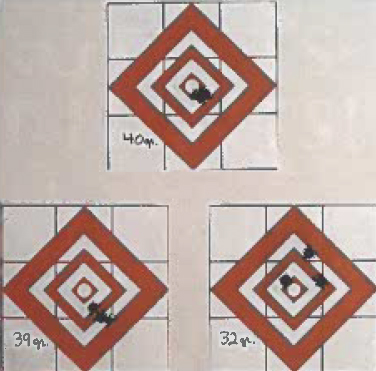
The .204 Ruger is a superb .20-caliber varmint cartridge suitable for shots out to 400 yards at coyotes and smaller varmints. Sighted for 200 yards, bullets of 32 and 40 grains with muzzle velocities of 3,900 to 4,200 fps impact approximately 0.75 inch high at 100 yards, 4 inches low at 300 yards, and 13 inches low at 400 yards . Trajectory is comparable to that of the .22-250 Remington, but due to the lighter bullets, bullet strikes are less evident. If I were limited to one varmint rifle, the .204 Ruger would be my choice.
The .22-caliber cartridges include the .223 Winchester Super Short Magnum (2003), .22 Nosler (2017), .224 Valkyrie (2018), .22 Creedmoor (2024), and .22 Advanced Rifle Cartridge (.22 ARC, 2024). Muzzle velocities range from 2,700 to 3,850 fps for bullet weights of 55 to 90 grains, depending on the cartridge and intended application. For varmints such as prairie dogs, woodchucks, foxes, and coyotes, bullets of 55 to 62 grains with velocities of 3,300 to 3,850 fps are preferred . Zeroed for 200 yards, bullet trajectory for the majority of these bullets will be approximately 1 to 2 inches high at 100 yards, 4 to 7 inches low at 300 yards, 13 to 20 inches low at 400 yards, and 33 to 40 inches low at 500 yards.
A few comments are in order about the suitability of the .22 Nosler, .224 Valkyrie, and .22 Creedmoor for large varmints, hogs, and deer. Heavy-for-caliber, high ballistic coefficient bullets of 64 to 90 grains with muzzle velocities of approximately 2,700 to 3,500 fps are recommended. Zeroed for 200 yards, bullet impacts will be approximately 1.5 inches high at 100 yards and 5 to 8 inches low at 300 yards.
The .22 Nosler with 70-grain AccuBond Trophy ammunition and the .224 Valkyrie with 78-grain Barnes Triple Shock X (TSX) ammunition are ballistic twins. Muzzle velocities of 2,950 and 2,805 fps, and muzzle energies of 1,352 and 1,407 ft.-lbs., respectively, make 200 yards about the maximum distance for shots at deer-sized game. Federal Premium also offers a 90-grain Fusion bullet load for the .224 Valkyrie with a muzzle velocity of 2,700 fps and a muzzle energy of 1,457 ft.-lbs.
The .22 Creedmoor, developed by Horizon Firearms and approved by the Sporting Arms and Ammunition Manufacturers’ Institute (SAAMI) in 2024 employs the 6mm Creedmoor parent case. It is now a commercially available round from Texas Ammunition, Copper Creek Cartridge Company, and Hornady. Offered in bullet weights of 60 to 95 grains, with an advertised muzzle velocity of 3,300 fps for the Hornady 80-grain Extremely Low Drag-Expanding (ELD-X) bullet, the .22 Creedmoor is a potent deer cartridge for shots out to 400 yards. Zeroed for 200 yards, the bullet impacts are 1 inch high at 100 yards, 4.9 inches low at 300 yards, and 14.3 inches low at 400 yards. In a 10-mph crosswind there is approximately 9 inches of wind deflection at 400 yards. Negative aspects of the .22 Creedmoor include the cost of ammunition, limited barrel life, loud report, and a recoil of approximately 9 ft.-lbs. for a 9 lb. rifle.
As a point of interest, the .22 Creedmoor is virtually identical to the .22XC, a cartridge based on the 6XC case developed by Roger’s Gun Works in 2008. The evolution and field testing of the .22XC is documented in the 2009 October-December issue of The Varmint Hunter Magazine and in Chapter 5 of Rifle Shots (2012), a book by this author.
The .22 ARC from Hornady is a brand-new cartridge based on the 6mm ARC case and chambered in AR-15s with 1:7-inch twist barrels. Ammunition is available in three bullet weights: a 62-grain Hornady ELD-VT V-Match varmint load at 3,300 fps, and 75-grain ELD Match Black and 88-grain ELD Match competition loads with muzzle velocities of 3,000 and 2,825 fps, respectively. At present, there are no big-game loads. However, a handloader wishing to use the .22 ARC for deer can easily load 75-grain hunting bullets. As with the .22 Nosler and .224 Valkyrie, shots at deer should be restricted to distances of less than 200 yards.
The .22 Nosler, .224 Valkyrie, .22 Creedmoor, and .22 ARC are often compared to the .22-250 Remington. These comparisons, however, are based on ballistics for the standard factory 55-grain loads for the .22-250 that have a muzzle velocity of 3,680 fps in bolt rifles with 24-inch, 1:12-inch twist barrels. If a .22-250 is fitted with a 1:8-inch twist barrel, cartridges can be handloaded with high ballistic coefficient bullets of 75 or 80 grains to provide muzzle velocities ranging from 3,100 to 3,300 fps.
Hornady 6mm Creedmoor and 6mm ARC
The 6mm Creedmoor (2017) and 6mm ARC (2024) are the latest 6mm cartridges to appear on the market. Developed for long-range competition, the 6mm Creedmoor employs a necked-down 6.5mm Creedmoor case, whereas the parent case for the 6mm ARC is a modified 6.5mm Grendel case that when loaded provides a cartridge that does not exceed the maximum 2.260-inch cartridge length for AR-15 magazines. The cases of both cartridges will accommodate heavy-for-caliber, high ballistic coefficient bullets recommended for long-range shooting.
Hornady 6mm bullets suitable for varmints, hunting, and competition include the new
80-grain ELD-VT V-Match, 103-grain ELD-X, 108 grain ELD-Match, and 90-grain copper alloy expanding CX bullets. The ELD-VT V-Match bullets are designed for both hunting and competition.
In a rifle with a 24-inch barrel chambered for the 6mm Creedmoor, the Hornady 103-grain ELD-X bullet will have muzzle velocity and energy values of 3,050 fps and 2,127 ft.-lbs., respectively. Energy at 400 yards is 1,261 ft.-lbs., which is adequate for deer-sized game. Out to approximately 400 yards, there is little difference in ballistics between those for the .243 Winchester 95-grain Ballistic Silvertip and the 6mm Creedmoor Hornady 103-grain ELD-X cartridges.
The 103-grain ELD-X bullet in the smaller 6mm ARC has a muzzle velocity of 2,800 fps. If used in an AR-15 with a barrel of 18 or 20 inches, muzzle velocity and energy are reduced, shortening the effective range for deer to approximately 200 to 250 yards.
Summary and Conclusion
Overall, the .17-, .20-, .22-, and 6mm cartridges discussed here are impressive. The .17 HMR is an excellent choice for ground squirrels, prairie dogs, and woodchucks out to approximately 175 yards. Within 200 to 250 yards, the .17 WSM and .17 Hornet are deadly on prairie dogs and woodchucks, and can handle coyotes at close range. These .17 cartridges are pleasant to shoot, and an excellent choice for hunters in populated areas.
The .204 Ruger is the cartridge of choice for prairie dogs out to 400 yards, and is suitable for fox and coyote. Twenty-two-caliber cartridges such as the .223 WSSM, .22 Nosler, and .224 Valkyrie, are excellent all-around cartridges for long-range applications on prairie dogs, woodchucks, foxes, and coyotes. With proper bullets and shot placement they are suitable for deer-sized game out to approximately 200 yards. The .22 Creedmoor is a power house for long-range shots at coyotes, hogs, and deer using high ballistic coefficient, heavy-for-caliber bullets at velocities in excess of 3,000 fps. The .22 ARC is brand new and designed to allow the use of heavy-for-caliber bullets in AR platforms.
Developed for competition, the 6mm Creedmoor is an excellent long-range cartridge suitable for coyotes, hogs, and deer out to plus 400 yards. The smaller 6mm ARC, used in an AR-15 rifle with a shorter barrel generates reduced velocity and energy that shortens the maximum effective distance for shots at deer to approximately 200 yards.
Matching the likely distance for shots with the size of quarry and cartridge parameters aids in the determination of an optimum cartridge for varmints and game. The cartridges discussed here, developed in the last 20 years, provide several choices worthy of consideration.